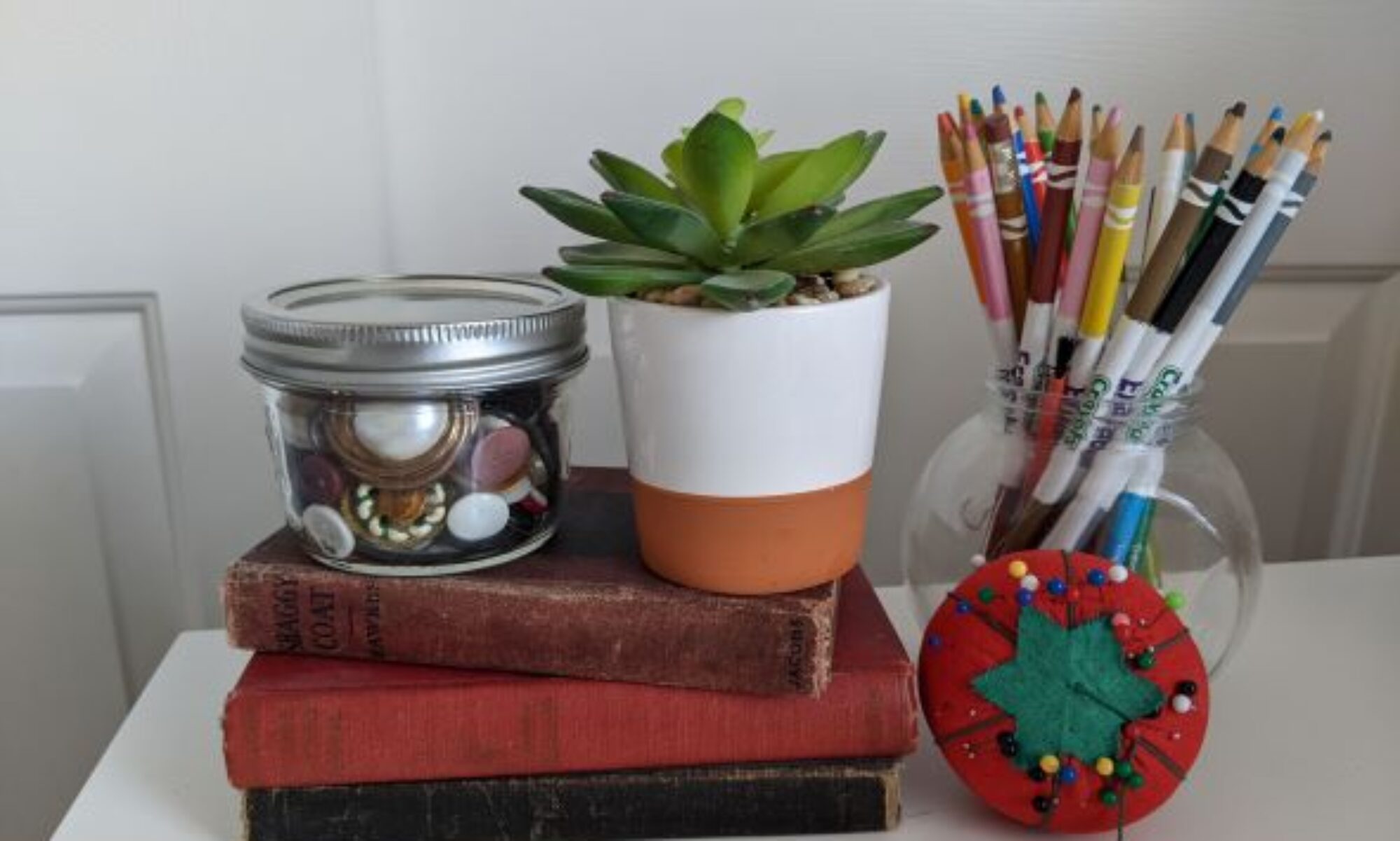
“The best investment is in the tools of one’s own trade.” -Benjamin Franklin
An Affair with Cookware
A few years ago, I published a humorous story about my husband’s infatuation with top-of-the-line cookware. Ed ,the household chef, spent months browsing online sites and gourmet shops in search for the perfect saute pan. In the end, he found what he was looking for.
My story ends with these words: “She’s a beauty–a sleek exterior with a professional ceramic nonstick, diamond sear coating and a glass lid. The newest addition to our cookware collection now has a place of honor on its designated shelf in the cupboard and I’ll have to say, despite being high maintenance, she outperforms the other cookware in our kitchen. She and my husband make an impressive pair, creating lovely dishes for company or everyday dinners for us.”
New Girl in the Sewing Studio
My husband is right, the correct tools make all the difference. I recently had an opportunity to acquire a new tool for my sewing studio. A friend of a friend wasn’t using her serger ( a specialized machine that finishes the seam edges as you sew), so I offered to give it a new home.
I’d been wanting a serger, the price was right, and it will add a professional touch to my hand-made clothing and craft projects. There will be a learning curve. She has four spools, two needles and and extensive instruction manual, but welcome Vivian! ( Yes, I name all my sewing machines 🙂
For the Love of Writing
So now for my other passion: writing. What are the tools needed for that endeavor? Of course there are the physical tools : pens, pencils, notebooks, journals, computer or typewriter. Each writer will have her or his own preferences here. But there are less tangible tools to include as well.
Stephen King (On Writing) say that every writer’s toolbox should have: vocabulary (voice), a fundamental knowledge of grammar, personal style, and commitment to the work.
Digging deeper Elizabeth Gilbert (Big Magic) says writers need COURAGE (“living a life that is driven more strongly by curiosity than by fear”) ENCHANTMENT (being ready and open when new ideas strike) PERMISSION (define yourself as a writer) PERSISTENCE (hold yourself together through all the phases of your writing journey) TRUST(trust yourself, your process, your work)
So there you have it! Here’s wishing you a gloriously abundant toolbox for your creative life!
Threads of Thought
What is your creative outlet? What tool (or tools) help you achieve your best work?
A book is a gift you can open over and over again. Gift yourself or a friend this season. Available now in paperback, eBook, or Kindle Unlimited.
We’ve all seen it at the movies or in a Hallmark drama. The dramatic conclusion where the struggling writer finally ties up all the loose ends and completes their story. The music swells and, with fingers flying, the actor clacks out those fateful words on the typewriter (it’s always a typewriter)THE END. Whew. Cheer. Roll the credits.
It happened to me last week! Too bad the cameras weren’t rolling, though I was on my computer and couldn’t yank a paper out and wave it in the air like they do in the movies. And, truth be told, I didn’t really type THE END, but I completed the last chapter of my third book! Ta Da! (picture me doing a little dance) Now if only I could put a link at the bottom of this post (along with its sister titles CRAYON BOX and UNTIL ITALY) and send my story out into the world along with its sister titles CRAYON BOX and UNTIL ITALY.
But no. What the movies don’t show is that the writer probably just completed what Anne Lamott calls the “shitty first draft.” I don’t especially like that term, perferring rough, unpolished, first draft, but you get the idea. A year in the making and that’s what I currently have. Now what?
Revision
This used to be my least favorite part of the writing process. When I first began to write, I preferred the start, getting the ideas down on paper, and watching the story unfold, then I wanted to be done. But some famous authors have helped me change my attitude towards revision.
Maggie Smith (poet and author of Dear Writer) reminds us that the word revision literally means “to see again” and it’s her favorite part of the writing process. Once the first draft is done, it’s her chance to look at it with fresh eyes, get at all the essential parts of the piece, maybe even take it in an entirely different direction. Whoa! That has already happened. My story is taking me places I hadn’t expected.
Stephen King (On Writing) explains that when you write your first draft, you are telling yourself the story. When you revise (or look again) your job is to take out all the things that are not the story. A little scary, Stephen. What if there’s nothing left? But I get it. I’m going to trust that my story won’t vanish into thin air and that what is left will be its true spirit.
Thinking of writers as artists, Rick Rubin (The Creative Act) refers to revision as curating your work. As curator, you decide what is included , what is not, and how it is all displayed in the final presentation. A curated work. I love this vision.
And a good friend recently told me “The hard part is done, now you get to play with it.” Perfect! What I once viewed as work can actually be my author’s playground!
So now, to step back, see my work with fresh eyes, take out all the things that are not the story, and curate the rest so my words comes to life just the way I want them to. And play.
Oh, this is going to be fun!
Threads of Thought
Sometimes authors set a completion goal and announce book releases. I’m not ready for that yet. Be patient with me. I plan to take all the time I need. Thanks to all my readers for hanging in there with me.
And here’s to the completed stories! If you haven’t had a chance to catch these yet, now’s a good time! Each one sets the stage for what’s to come!
Sleepless in Seattle? Not quite, but on my recent trip I was so excited to be in this iconic city I almost didn’t want to waste any time sleeping! One of my goals as a writer and blogger is to create articles that you can relate to, stories that make you smile, think, or encourage you on your own journey . With that in mind, welcome to Seattle!
Pike Place Market
Though one of the most acclaimed tourist attractions, Pike Place Market is, and always has been, a real working market selling fresh local produce, breads, pastries, flowers, artwork, crafts, and yes, the fish fly. Hubby Ed bought shrimp and smoked salmon that he turned into delicious dinners back at the Airbnb. Fun fact: we learned that the fishmongers throw the same fish around all day for the tourists, then donate it to the local zoo for the bears. When we bought our shrimp, the fishmonger threw it to us! (after packaging it, not one shrimp at a time 🙂
Space Needle
You can’t visit Seattle without a trip to the Space Needle. Built in Seattle for the 1962 World’s fair, this architectural wonder draws approximately a million people each year. The day we were there, the top of the needle was enveloped in cloud cover and we didn’t get to see the panoramic view of the city and Puget Sound . That was fine with my three travel companions who are afraid of heights. As consolation for the views I missed, I coaxed Ed to stand next to me on the glass floor of the observation deck for a few seconds while a friend snapped this picture from above. He refused to look to down to the ground 520 feet below.
Chihuly Glass Museum
This museum, only steps from the Space Needle, took my breath away! Room after room of astonishing glass art will transport you to another world. Plan to visit the glass blowing demonstration in the courtyard to witness artists in action, and a stop at the theater room provides insights into Chihuly’s process, mission, and vision. In one of the films, Chihuly describes his creative process as “being driven by spontaneity.” He goes on to say that if he stops to think about it too much, the work loses something. I came away inspired to embrace this idea in my creative endeavors.
The Origin of Starbucks
Seattle is the birthplace of Starbucks. Though the original site no longer exists, this shop in Pike Place market has the distinction of being the oldest Starbucks in the nation and is the historical mecca of Starbucks fanatics. Sadly, I didn’t get to go into the shop due to the long, long, line outside that snaked around like a popular attraction at Disney World. Fun fact: the original logo designed in 1971 (as shown on the window behind me) was brown and white and depicted a bare-breasted, two-tailed siren. (Huh…I always thought she was a mermaid.) This mythological creature known for her enchanting song represented the allure of coffee, drawing customers in. Today’s logo now features a modest siren, signature green color, and is so iconic, no words are needed.
Mt. Rainier
A few hours from Seattle, and not to be missed on your itinerary, is Mt. Rainier, the Pacific Northwest at its finest. At over 14,000 feet the mountain is the tallest volcano in the Cascade Mountain Range and the most glaciated peak in the United states. We booked a day trip from Seattle and were soon transported away from the city and into this beautiful wilderness. At the park we hiked through conifer forests, felt the spray of magnificent waterfalls, and witnessed glacier flows down the mountain. At the Paradise stop, we grabbed some lunch, shopped for souvenirs. and strolled through the meadow trail where black tailed deer enjoyed the pleasant September weather.
Honorable Mention…
Besides the main attractions above, this post would be amiss if I didn’t mention our cruise around the harbor, a visit to Ballard Locks where we saw salmon run (or swim) upstream in the salmon ladder, the Seattle Aquarium, amazing seafood at the Athenian restaurant and Ivar’s Acres of Clams (yes, acres), and fresh pastries each morning from Macrina Bakery conveniently located next door to our Airbnb.
Sleepless in Seattle? Maybe breathless would be a better description.
Threads of Thought
Have you visited Seattle? What were some of your favorite memories?
What activities/places in or around Seattle would you like to visit?
For more adventures, read on! My books are available in paperback, eBook, or Kindle Unlimited.
It’s officially autumn in the northern hemisphere. Judging by social media posts, many of you are wearing sweaters, welcoming fall colors, and drinking all things pumpkin spice. So why am I sitting by the pool in shorts and a tee shirt and drinking iced tea? Because it’s not autumn in my part of Arizona yet. Here’s why:
Six Seasons?
Though some say there are officially 5 seasons here in the Sonoran Desert, others divide our year into six distinct seasons. On a recent trip to the Sabino Canyon visitors’ center near Tucson, I saw an informative display that made perfect sense to me. I used to think that this part of the country was barren, hot and dry all year. Maybe you have that image in mind as well. But having lived her for over a decade, I’ve come to appreciate the beauty of each season in the desert. Here’s the breakdown of a “typical” year.
Winter
Winter hiking
December to January: Winter is typically sunny and mild, daytime temps in the 60s, nights may occasionally drop below freezing. The jagged peaks of nearby Mt. Lemmon are often snow covered and, once, I woke to a dusting of snow on our patio. I scooped up a handful and made a little snowman. He was gone by noon. After Christmas, Snowbirds (people who winter here) flock to enjoy sunny days and mild temps. Crisp air and blue sky make for perfect hiking weather.
Spring
Palo Verde trees burst into bloom
February to April: Expect mild temperatures, occasional light rain. This is the main flowering season for winter annuals. Hikers and birdwatchers flock to the trails to observe wildflowers and migrating birds. Palo Verdes (the state tree) sprout golden blossoms from green branches. Bees buzz around crimson blossoms on my pomegranate tree and neighbors share bountiful citrus harvests.
Foresummer Draught/ Dry Summer
Saguaro Cactus Blooms
May-June : Here it comes–the high temperatures, often pushing into triple digits, and extremely low humidity. Most desert life is in survival mode during this time. Iconic saguaro cacti have adapted to store large amounts of water in their spongy stems that expand and contract like an accordion. They crown themselves with waxy white blossoms during this season, show-offs in the otherwise prickly environment. This is the off-season for tourist attractions in the area. It’s best to stay indoors as much as possible during the day. Hats, sunscreen, and water are the survival tools for those who venture out. Even so, hiking can be dangerous.
Wet Summer/Monsoon
Rain falls in the thirsty desert
July to mid-September: Just when you think you can’t stand the heat anymore, here comes the Monsoon. This season is celebrated! In a good year, more than half the annual rainfall may fall during these months. Temperatures drop, the wind picks up, and billowy dark clouds fill the sky followed by dramatic lighting shows and rumbles of thunder. When storms subside, people rush to see water flowing in the usually dry streams, “rivers”, and washes. This is a major growing season for most plants.
Late Summer
Late Summer sunset
September to mid -October: some include this short season between monsoons and autumn. Don’t put away your shorts and bathing suits just yet. This period can be hot and dry. I pretend it’s autumn by putting up a fall wreath, and going out for a pumpkin spice latte (iced) while waiting for the “real fall” to arrive. On the plus side, the days are getting shorter and the sun is gentler this time of year making sunsets even more spectacular.
Autumn
Late October-November: Autumn finally arrives. Cool, crisp salads make way for soups, stews, and spicy chili. After dinner, you can gather around the tire table or stoke up your mesquite fire pit and make s’mores. My pomegranate tree is heavy with fruit waiting to be harvested and it will soon drop its leaves. Halloween decorations pop up all over the neighborhood and trick-or-treaters will soon be here. You might even need to throw on a light sweater or jacket. Then you will know autumn has finally arrived in Arizona.
Yeah, I know. The desert environment is not for everyone. Those of you who live in other parts of the country will have beautiful leaves, the first snowfall, White Christmas. I miss it sometimes. But come January, February, and March, when Midwestern friends and family members begin to tire of cold, gray, slushy days, my guest room fills up.
Threads of Thought
What is autumn like where you live?
Do you have a favorite season?
Fall into a good book! Out of the Crayon Box: Thoughts on Teaching, Retirement, and Life and Until Italy: A Traveler’s Memoir are available in paperback, eBook, and Kindle Unlimited
The idea came to me on New Year’s Day, 2024 when I saw a social media post for the 52 Hike Challenge: “A challenge where you gain physical fitness, mental well-being, make new friends, explore new places and connect with friends, family, and yourself through nature.“
The program encouraged one hike a week (described as any walk outdoors for a mile or more) for 52 weeks. After conferring with husband Ed, I signed us up. The challenge was on!
The inspiration…
As a writer, I planned to track my hikes through journaling, but wanted a visual record as well. What if I sewed something? A quilt or small wall hanging? I could use a color or pattern for each type of hike, or maybe select a fabric to represent each experience. The pattern would be random, patchwork, but yes! This could work!
The plan…
Full disclosure: I’m a sewist, but not a quilter. I would need some help. I called on a friend , who just happens to be a quilter and a mathematician. Over lunch, she drew a series of squares and measurements on a scrap of paper while we ate our sandwiches:
“Triangles make an interesting pattern. Let’s see… 52 triangles would make 26 squares. If you added two accent squares you could do a small quilt with 7 columns and 4 rows. It would make a nice wall hanging.”
Yikes. Lots of math but I had a plan.
The Fabric
At the Cactus Quilt Shopin Tucson, I spent a glorious morning picking out fabric. With a color scheme in mind—desert hues of rust, gold, umber, sage, with splashes of turquoise—I filled my basket with bits of prints and solids, sunbursts and tiny cacti, abstract lines and dots. I couldn’t resist buying a fat quarter (a pre-cut quarter yard) of whimsical black fabric with wild suns, and lizards. For accent borders and backing material, I purchased two yards of cotton in a rich shade of cinnamon.
Measure twice, cut once
A rule for carpenters, it works for quilters as well. Back at my friends house, I measured and cut the fabric into 4.5 inch squares, then cut them diagonally into triangles. Interior border strips were cut in 1.5 inch widths, outer border in 2.5 inch strips. I also decided to add accent squares in a neutral beige leaf pattern. I cut these in 1.5 inch squares.
Construction
At the completion of every 2 hikes, I used my machine to sew a pair of triangles together (using a quarter-inch seam) to make a square. As our hiking year progressed, it was satisfying to see the patterns of squares and triangles emerge. To make the math come out even, I made two additional squares using the “badge” I’d earned from the 52 Hike Challenge, and a small embroidery piece I stitched up from a kit. Once we had completed all 52 hikes ( no small task, mind you and that’s a story for another day), I laid the squares out in various configurations with the borders and accent squares until I found the design I wanted, then began to stitch the quit top together. With the help of a YouTube video, I assembled the finished top, batting, and backing using the “envelope method.”
Finishing touches
To finish the quilt, I top-stitched the edges of the border with my sewing machine. Since this was a small project, I decided to “tie” the quilt by sewing a vintage button onto each accent square.
Ta-da!
I’m happy with how the quilt turned out! I have a few ideas on where to display it in my home. We’ll see where it wants to live. But wherever it ends up, it will be a beautiful reminder of the year we hiked.
More to the story?
As I stitched my quilt together, I was also piecing together the stories that each hike had to tell. Like the hikes themselves, this work is taking me to unexpected places. A third book? Hmmm…
Threads of Thought
Let’s get creative! Sewing, knitting, painting, writing? In what ways have you , or could you imagine yourself, interpreting a life event?
Read on! My first two books Until Italy: a Traveler’s Memoir and Out of the Crayon Box: Thoughts on Teaching, Retirement, and Life are available in paperback, eBook, and Kindle Unlimited. Click here!